

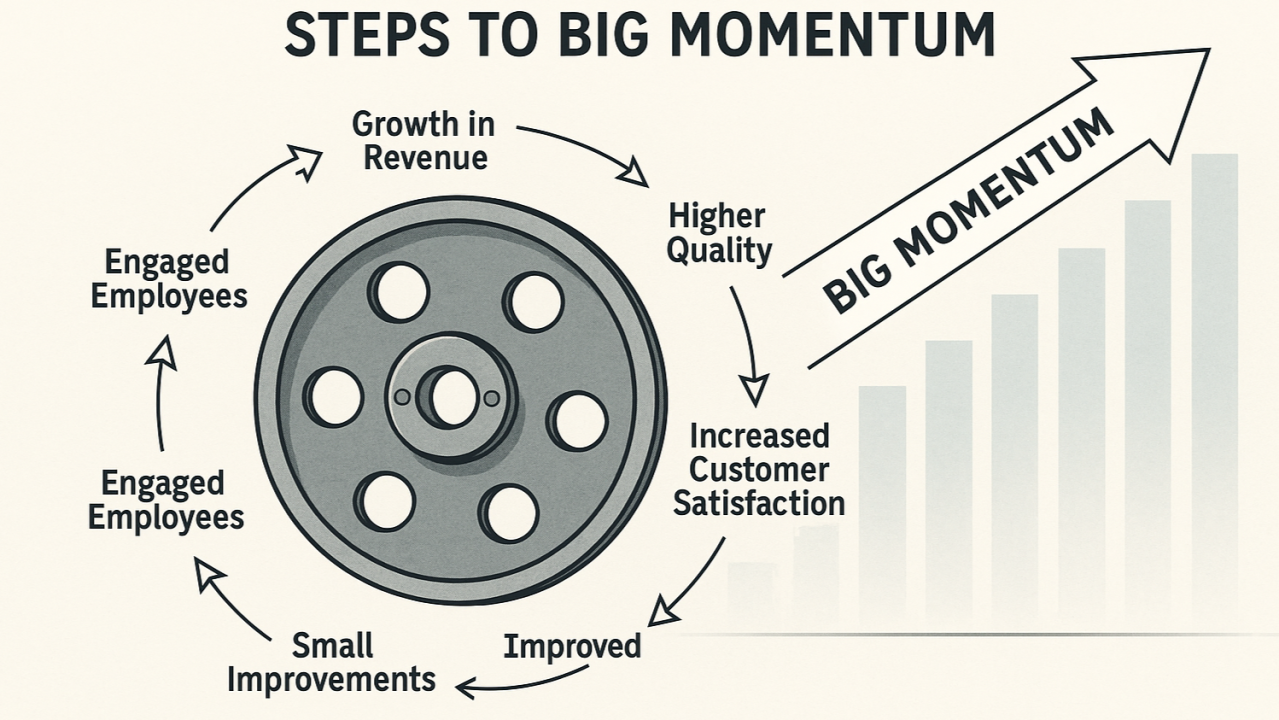
The concept of the Flywheel Effect, introduced by Jim Collins, captures a truth about how organisations achieve lasting success. It’s the idea that exceptional performance doesn’t come from one hero-like action or bold initiative, but from the cumulative impact of consistent, disciplined effort. Like pushing a massive flywheel, each steady push builds momentum until it revolves under its own force.
At its core, the Flywheel Effect rejects the myth of a ‘quick fix’. Instead, it promotes the power of compounded progress: the steady rhythm of behaviours, rituals, and habits that create a self-reinforcing cycle of success. It’s a concept that resonates with both high-performing private organisations and mission-driven public sector bodies … though the latter often face greater challenges in maintaining momentum amid constant change.
“Greatness is not a function of circumstance. Greatness, it turns out, is largely a matter of conscious choice and discipline.”— Jim Collins, Good to Great
Turning the Flywheel
In Collins’ research, companies that transitioned from good to great didn’t rely on one defining moment, a visionary CEO, or a single strategy. Rather, they committed to a clear purpose, disciplined people, and consistent actions, even when the payoff wasn’t immediate! Each disciplined act was a turn of the flywheel, adding energy and pace. Over time, those small, aligned actions produced exponential performance gains.
Applied to organisational culture, the Flywheel Effect reinforces that the right behaviours, repeated consistently, build cultural gravity. When everyone pushes in the same direction – leaders modelling desired behaviours, teams aligning around shared values, and systems reinforcing them – the culture begins to move forward almost naturally.
The Flywheel in Action
Consider Amazon, one of the most famous examples of the Flywheel in action. Jeff Bezos famously designed the “Amazon Flywheel” to visualise how the company’s ecosystem worked: lower prices lead to more customer visits; more customers attract more sellers; more sellers expand selection; and greater selection improves customer experience — which then feeds back into growth. Each element strengthens the others, creating a virtuous cycle.

Across public sector organisations, similar patterns can be seen where sustained, incremental improvement has been prioritised over one-off initiatives. Small, repeatable habits such as regular team huddles, short reflection sessions, and peer learning forums, can steadily build trust, alignment, and performance. Over time, these ‘micro-actions’ compound, shaping stronger collaboration, innovation, and service outcomes. There’s rarely one defining breakthrough moment, just the accumulation of thousands of small improvements reinforcing each other.
Even in education or local government, leaders who build consistent rituals of reflection and recognition such as weekly “what’s working” reviews or shared learning forums, often see their culture accelerate organically. The energy builds not from new projects but from sustained discipline.
Creating Momentum: Practical Steps to Propel your Flywheel
So how can organisations and individuals start turning their own flywheel? The answer lies in making progress visible and habitual. Some practical steps include:
- Define your flywheel: Identify 4-5 interconnected elements that drive your organisation’s success (for example: engaged people, better collaboration, improved outcomes, increased trust, greater engagement). Make the cycle explicit and visible.
- Start small, stay consistent: Choose a few non-negotiable habits and protect them, such as daily check-ins, monthly reflection sessions, or consistent recognition of desired behaviours.
- Measure progress, not perfection: Track momentum through small wins, stories, and early indicators. The goal is to show movement, not mastery.
- Empower champions: Identify individuals who naturally model the desired culture. Give them autonomy to drive small improvements and celebrate their impact.
- Communicate relentlessly: Keep reinforcing the narrative of progress and use storytelling to make cultural momentum tangible and meaningful.
By doing this, momentum becomes collective. The flywheel begins to turn not because of top-down pressure, but because people across the organisation feel the satisfaction of shared progress.
Behaviour, Ritual, and Habit: The Real Drivers
Organisational success isn’t born from grand strategies alone; it’s shaped by the everyday behaviours that compound over time. When individuals habitually live the organisation’s values, when leaders repeatedly show up with consistency and clarity, when teams continually share learning and celebrate progress — that’s when momentum becomes self-sustaining.
The Flywheel Effect, then, is less about speed and more about direction and discipline. It teaches us that sustainable high performance, especially in complex, ever-changing environments, comes not from doing everything at once, but from doing the right things consistently.
As Collins reminds us, greatness is a matter of conscious choice and discipline. For the public sector, that means choosing to protect and nurture the habits that create stability amid turbulence, ensuring that no matter how the external context shifts, the internal flywheel keeps turning.
Final Reflections…
The essence of the Flywheel Effect is simple yet powerful: momentum follows consistency. When people and organisations commit to the small, disciplined actions that align with their purpose, they build resilience and performance that endure. In a world of constant change, it’s not the speed of transformation that defines success, but it’s the ability to keep moving forward, one deliberate turn at a time.
The takeaway? Start small. Stay consistent. Protect the habits that matter. Over time, those steady pushes will generate their own energy and that’s when the flywheel truly takes on a life of its own.

Leave a Reply